import tensorflow as tf from tensorflow import keras import numpy as np import os %matplotlib inline import matplotlib.pyplot as plt import glob
查看Tensorflow版本
仅在需要时申请显存空间
程序初始运行时消耗 很少的显存,随着程序的运行而动态申请显存;GPU 的显存使用策略设置为 “仅在需要时申请显存空间”)
1
2
3
| gpus = tf.config.list_physical_devices(device_type='GPU')
for gpu in gpus:
tf.config.experimental.set_memory_growth(device=gpu, enable=True)
|
glob读取路径
训练数据
1
2
| img = glob.glob('E:images/leftImg8bit/train/*/*.png') # tf.io.glob.glob
label = glob.glob('E:images/gtFine/train/*/*_gtFine_labelIds.png')
|
训练数据乱序
1
2
3
4
| index = np.random.permutation(len(img))
img = np.array(img)[index]
label = np.array(label)[index]
|
测试数据
1
2
| img_val = glob.glob('E:images/leftImg8bit/val/*/*.png')
label_val = glob.glob('E:images/gtFine/val/*/*_gtFine_labelIds.png')
|
Dataset
训练数据Dataset
1
| dataset_train = tf.data.Dataset.from_tensor_slices((img, label))
|
测试数据Dataset
1
| dataset_val = tf.data.Dataset.from_tensor_slices((img_val, label_val))
|
图片读取函数
1
2
3
4
| def read_png(path):
img = tf.io.read_file(path)
img = tf.image.decode_png(img, channels=3)
return img
|
1
2
3
4
| def read_png_label(path):
img = tf.io.read_file(path)
img = tf.image.decode_png(img, channels=1)
return img
|
数据增强函数
1.随机翻转 img = tf.image.flip_left_right()
2.随即裁剪
1
2
3
4
5
6
| def crop_img(img, mask):
concat_img = tf.concat([img, mask], axis=-1)
concat_img = tf.image.resize(concat_img, (280, 280),
method=tf.image.ResizeMethod.NEAREST_NEIGHBOR)
crop_img = tf.image.random_crop(concat_img, [256, 256, 4])
return crop_img[ :, :, :3], crop_img[ :, :, 3:]
|
归一化函数
1
2
3
4
| def normal(img, mask):
img = tf.cast(img, tf.float32)/127.5 -1
mask = tf.cast(mask, tf.int32)
return img, mask
|
图片加载函数
训练图片加载
1
2
3
4
5
6
7
8
9
10
11
12
13
| def load_image_train(img_path, mask_path):
img = read_png(img_path)
mask = read_png_label(mask_path)
img, mask = crop_img(img, mask)
if tf.random.uniform(())>0.5:
img = tf.image.flip_left_right(img)
mask = tf.image.flip_left_right(mask)
img, mask = normal(img, mask)
return img, mask
|
测试图片加载
1
2
3
4
5
6
7
8
9
10
| def load_image_val(img_path, mask_path):
img = read_png(img_path)
mask = read_png_label(mask_path)
img = tf.image.resize(img, (256, 256))
mask = tf.image.resize(mask, (256, 256))
img, mask = normal(img, mask)
return img, mask
|
设置BACTH_SIZE、BUFFER_SIZE、step_EPOCH
1
2
3
4
| BCTCH_SIZE = 8
BUFFER_SIZE = 300
step_per_epoch = train_count//BCTCH_SIZE
val_step = val_count//BCTCH_SIZE
|
设置AUTOTUNE
1
| auto = tf.data.experimental.AUTOTUNE
|
将加载函数map到dataset
1
2
| dataset_train = dataset_train.map(load_image_train, num_parallel_calls=auto)
dataset_val = dataset_val.map(load_image_val, num_parallel_calls=auto)
|
设置train、val数据集batch等
1
2
| dataset_train = dataset_train.shuffle(BUFFER_SIZE).batch(BCTCH_SIZE)
dataset_val = dataset_val.batch(BCTCH_SIZE)
|
定义LinkNet模型
编写卷积模块
编写卷积模块: 1.conv 2.bn 3.relu
1
2
3
4
5
6
7
8
9
10
11
12
13
| class ConvBlock(keras.layers.Layer):
def __init__(self,units,k_size=3,stride=1,use_bias=False):
super(ConvBlock,self).__init__()
self.conv = keras.layers.Conv2D(units,
kernel_size=k_size,
strides=stride,
padding='same',
use_bias=use_bias)
self.bn = keras.layers.BatchNormalization()
def call(self,x):
x = self.conv(x)
x = tf.nn.relu(self.bn(x))
return x
|
编写反卷积模块
编写反卷积模块: 1.conv 2.bn 3.act
1
2
3
4
5
6
7
8
9
10
11
12
13
14
| class DeconvBlock(keras.layers.Layer):
def __init__(self,units,k_size=3,stride=2, use_bias=False):
super(DeconvBlock,self).__init__()
self.deconv = keras.layers.Conv2DTranspose(units,
kernel_size=k_size,
strides=stride,
padding='same',
use_bias=use_bias)
self.bn = keras.layers.BatchNormalization()
def call(self,x,is_act=True):
x = self.deconv(x)
if is_act:
x = tf.nn.relu(self.bn(x))
return x
|
编写encode block
1
2
3
4
5
6
7
8
9
10
11
12
13
14
15
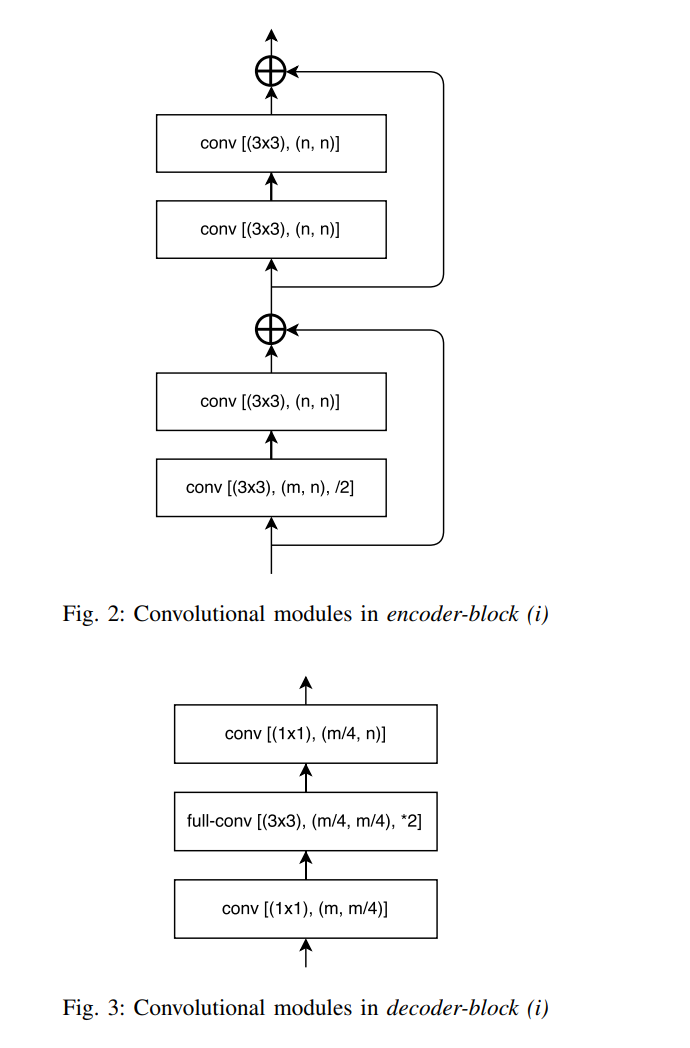
| class EncodeBlock(keras.layers.Layer):
def __init__(self,units):
super(EncodeBlock,self).__init__()
self.conv1_1 = ConvBlock(units, stride=2)
self.conv1_2 = ConvBlock(units, stride=1)
self.conv2_1 = ConvBlock(units, stride=1)
self.conv2_2 = ConvBlock(units, stride=1)
self.shortcut = ConvBlock(units, stride=2)
def call(self, x):
out1 = self.conv1_1(x)
out1 = self.conv2_1(out1)
residue = self.shortcut(x)
out2 = self.conv2_1(out1 + residue)
out2 = self.conv2_2(out2)
return out2 + out1
|
编写Decode block
1
2
3
4
5
6
7
8
9
10
11
| class DecodeBlock(keras.layers.Layer):
def __init__(self, units1, units2):
super(DecodeBlock, self).__init__()
self.conv1 = ConvBlock(units1, k_size=1)
self.deconv = DeconvBlock(units1)
self.conv2 = ConvBlock(units2, k_size=1)
def call(self, x):
x = self.conv1(x)
x = self.deconv(x)
x = self.conv2(x)
return x
|
编写Net
1
2
3
4
5
6
7
8
9
10
11
12
13
14
15
16
17
18
19
20
21
22
23
24
25
26
27
28
29
30
31
32
33
34
35
36
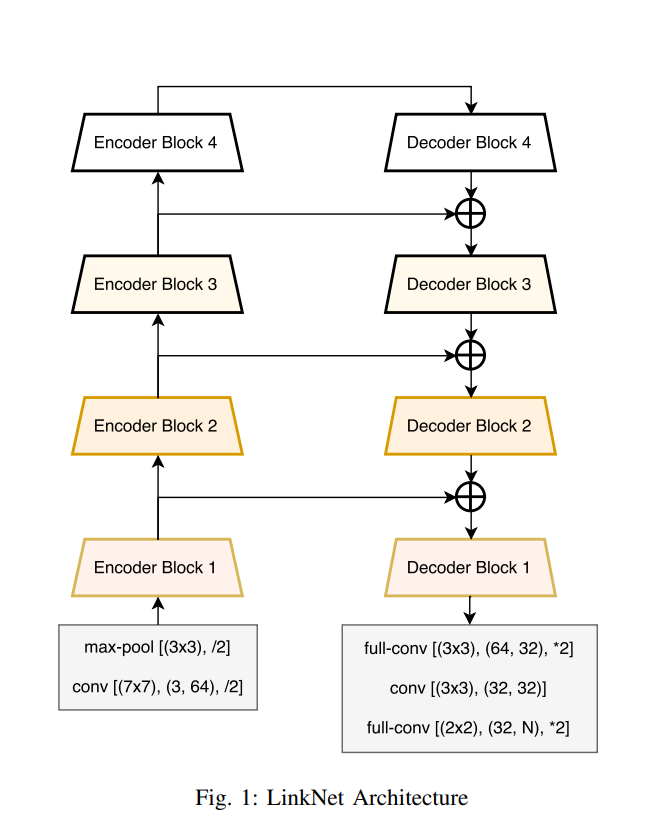
| class Net(keras.Model):
def __init__(self):
super(Net,self).__init__()
self.input_conv = ConvBlock(64, k_size=3, stride=2)#256X256 -> 128
self.input_maxpool = tf.keras.layers.MaxPooling2D(padding='same')#64
self.encode1 = EncodeBlock(64)#32
self.encode2 = EncodeBlock(128)#16
self.encode3 = EncodeBlock(256)#8
self.encode4 = EncodeBlock(512)#4 4*4*512
self.decode4 =DecodeBlock(512//4,256) #8*8*256
self.decode3 =DecodeBlock(256//4,128)
self.decode2 =DecodeBlock(128//4,64)
self.decode1 =DecodeBlock(64//4,64)
self.deconv_last1 = DeconvBlock(32)
self.conv_last = ConvBlock(32)
self.deconv_last2 = DeconvBlock(34,k_size=2)
def call(self, x):
x = self.input_conv(x) # (6, 128, 128, 64)
x = self.input_maxpool(x) # (6, 64, 64, 64)
e1 = self.encode1(x) # (6, 32, 32, 64)
e2 = self.encode2(e1) # (6, 16, 16, 128)
e3 = self.encode3(e2) # (6, 8, 8, 256)
e4 = self.encode4(e3) # (6, 4, 4, 512)
d4 = self.decode4(e4) + e3
d3 = self.decode3(d4) + e2
d2 = self.decode2(d3) + e1
d1 = self.decode1(d2)
l1 = self.deconv_last1(d1)
l2 = self.conv_last(l1)
l3 = self.deconv_last2(l2,is_act=False)
return l3
|
模型调用
绘制模型数据流向
1
| tf.keras.utils.plot_model(model) # conda install pydot
|
设置IoU
1
2
3
4
| class MeanIoU(tf.keras.metrics.MeanIoU):
def __call__(self, y_true, y_pred, sample_weight=None):
y_pred = tf.argmax(y_pred, axis=-1)
return super().__call__(y_true, y_pred, sample_weight=sample_weight)
|
设置optimizer
1
| optimizer = tf.keras.optimizers.Adam(learning_rate=0.0001)
|
设置损失(SparseCategoricalCrossentropy)
1
| loss_object = tf.keras.losses.SparseCategoricalCrossentropy(from_logits=True)
|
设置train、test的loss、accuracy、iou
1
2
3
4
5
6
7
| train_loss = tf.keras.metrics.Mean(name='train_loss')
train_accuracy = tf.keras.metrics.SparseCategoricalAccuracy(name='train_accuracy')
train_iou = MeanIoU(34, name='train_iou')
test_loss = tf.keras.metrics.Mean(name='test_loss')
test_accuracy = tf.keras.metrics.SparseCategoricalAccuracy(name='test_accuracy')
test_iou = MeanIoU(34, name='test_iou')
|
设置train数据每步
1
2
3
4
5
6
7
8
9
10
11
| @tf.function
def train_step(images, labels):
with tf.GradientTape() as tape:
predictions = model(images)
loss = loss_object(labels, predictions)
gradients = tape.gradient(loss, model.trainable_variables)
optimizer.apply_gradients(zip(gradients, model.trainable_variables))
train_loss(loss)
train_accuracy(labels, predictions)
train_iou(labels, predictions)
|
设置test数据每步
1
2
3
4
5
6
7
8
| @tf.function
def test_step(images, labels):
predictions = model(images)
t_loss = loss_object(labels, predictions)
test_loss(t_loss)
test_accuracy(labels, predictions)
test_iou(labels, predictions)
|
进行训练
1
2
3
4
5
6
7
8
9
10
11
12
13
14
15
16
17
18
19
20
21
22
23
24
25
26
27
| EPOCHS = 80
for epoch in range(EPOCHS):
# 在下一个epoch开始时,重置评估指标
train_loss.reset_states()
train_accuracy.reset_states()
train_iou.reset_states()
test_loss.reset_states()
test_accuracy.reset_states()
test_iou.reset_states()
for images, labels in dataset_train:
train_step(images, labels)
for test_images, test_labels in dataset_val:
test_step(test_images, test_labels)
template = 'Epoch {:3d}, Loss: {:.3f}, Accuracy: {:.3f}, IOU: {:.3f}, \
Test Loss: {:.3f}, Test Accuracy: {:.3f}, Test IOU: {:.3f}'
print (template.format(epoch+1,
train_loss.result(),
train_accuracy.result()*100,
train_iou.result(),
test_loss.result(),
test_accuracy.result()*100,
test_iou.result()
))
|
模型保存
1
| model.save_weights('city_weight_LinkNet.h5')
|
进行图片预测
1
2
3
4
5
6
7
8
9
| test_path = 'test.png'
test_png = read_png(test_path)
test_png = tf.image.resize(test_png,(256,256),
method=tf.image.ResizeMethod.NEAREST_NEIGHBOR)
test_png = tf.cast(test_png,tf.float32)/255
test_img =test_png
test_png = np.expand_dims(test_png,0)#扩张维度
test_pred = model.predict(test_png)
test_p = np.argmax(test_pred,axis=-1)
|
绘制预测图片
1
2
3
4
| plt.subplot(1,2,1)
plt.imshow(np.squeeze(test_img.numpy()))
plt.subplot(1,2,2)
plt.imshow(np.squeeze(test_p))#squeeze 函数:从数组的形状中删除单维度条目,即把shape中为1的维度去掉
|